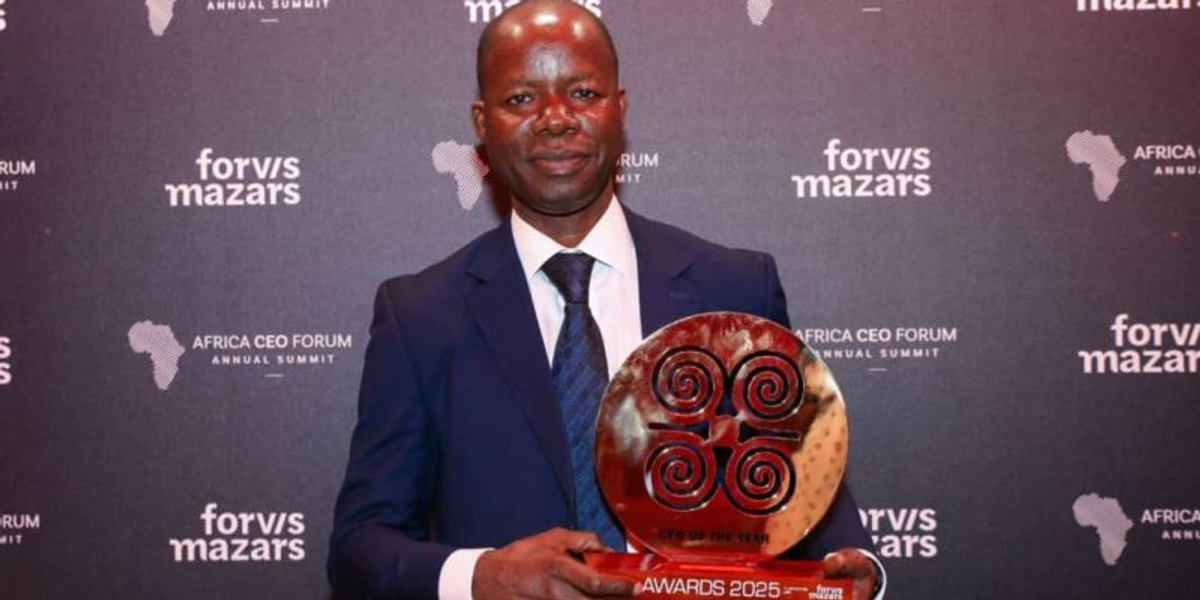
Voices of African CEOs: Idrissa Nassa, Africa's 2025 CEO of the Year

Andy Akinbamini
Click to view profile
From humble beginnings as a microfinance outfit in Burkina Faso, Idrissa Nassa has steadily built a pan-African empire from the ground up. His remarkable journey earned him the prestigious CEO of the Year award at the 2025 Africa CEO Forum, organised by Jeune Afrique Media Group in partnership with global consultancy Mazars. Now leading Coris Bank International as the third-largest banking group in the West African Monetary Union, with a close to 10 percent market share, Nassa operates in all eight UEMOA countries, as well as Guinea, Chad, and Cabo Verde. His story exemplifies leadership in Africa at its finest, demonstrating how vision, persistence, and strategic thinking can transform a struggling financial institution into a regional powerhouse.
The African CEOs' insights that Nassa shares reveal a leader who understands that sustainable growth requires more than financial acumen. Starting with just $3 million in capital in 2008, Coris Bank now manages over $9 billion in assets, a testament to Nassa's ability to identify opportunities others overlook and execute strategies that create lasting value. His leadership philosophy centres on financial inclusion, regional integration, and bold strategic moves that position African institutions to compete globally whilst remaining deeply rooted in the local communities they serve.
The Journey: From Bicycles to Banking Empire
Idrissa Nassa's entrepreneurial journey began far from boardrooms and banking halls. Born in Burkina Faso, he started his career in 1984 in the bicycle industry and international trade. By 1990, he had become one of the leading traders of consumer goods in West Africa, demonstrating early mastery of regional commerce and cross-border business dynamics. Starting in 1995, Nassa diversified his investments into real estate, hospitality, and the graphic arts industry, revealing a key aspect of his leadership approach in Africa: never putting all resources into a single sector.
The pivotal moment came in 2001 when Nassa acquired the struggling Financière du Burkina. In 2008, he relaunched it as Coris Bank International, with a clear vision of becoming a leading pan-African financial institution serving SMEs and underbanked populations. Under his leadership, CBI quickly became one of the leading banks in Burkina Faso before expanding across West Africa. Today, Coris operates in Côte d'Ivoire, Mali, Benin, Togo, Niger, Senegal, Guinea-Bissau, and Guinea, with its recent acquisition of Société Générale's Chad subsidiary marking entry into Central Africa.
Strategic Vision: Building Through Acquisitions and Partnerships
Nassa's leadership in Africa excellence shines brightest in its acquisition strategy. Following the acquisition of Standard Chartered's operations in Côte d'Ivoire, Coris Bank completed the purchase of a 67.8 percent stake in Société Générale's subsidiary in Chad. These weren't opportunistic deals but strategic moves to acquire established operations, experienced personnel, and existing customer relationships in key markets. His next target is Gabon, where he met with transitional President Brice Clotaire Oligui Nguema in Libreville to explore possibilities, demonstrating persistence that characterises outstanding leadership in Africa, even when individual deals face regulatory obstacles.
Recent insights from African CEOs reveal Nassa's continued commitment to growth through strategic partnerships. In October 2025, Coris Holding received €100 million in fresh co-investment from Mediterrania Capital Partners and a consortium of European development finance institutions, including FMO, British International Investment, BIO from Belgium, and Impact Fund Denmark. Beyond traditional banking, Nassa has led strategic diversification into mining and petroleum distribution through Coris Investment Group, acquiring TotalEnergies' downstream assets in Burkina Faso and securing majority stakes in gold mines across Mali and Guinea through subsidiary Nioko Resources.
Financial Inclusion: The Core Mission
Central to Nassa's leadership philosophy is an unwavering commitment to financial inclusion. Coris Bank's credo centres on small and medium enterprises, contributing to access to financing for businesses often overlooked by larger financial institutions. In Niger, Nassa personally reassured the Prime Minister of Coris's commitment to supporting the country's economy through financing projects and structures, particularly for SMEs and actors in the informal sector, which represent nearly 40 percent of GDP. The bank's Togolese unit alone serves over 79,000 customers, with 196,000 users on its e-money platform, Coris Money, which was launched in July 2022 as part of a push for financial inclusion.
Nassa's African CEOs' insights on financial inclusion emphasise technology's role in reaching underserved populations. Customer deposits have grown to $496 million while net loans stand at $331 million, proving that serving previously underbanked populations can be commercially viable. Major project financing further demonstrates Coris's commitment, including a $100 million credit facility for the Kiaka Gold Project as part of a larger $265 million secured loan, which enables the development of significant mining infrastructure that creates employment and generates export revenue.
Leadership Lessons: What Aspiring Executives Can Learn
Nassa's journey offers multiple lessons for aspiring business leaders across Africa. First, diversification builds resilience and creates learning opportunities that enhance overall business acumen. His experience across industries such as bicycles, consumer goods, real estate, hospitality, and graphic arts prepared him for the complexities of banking far better than a finance-only background would. Second, transformation requires patience and persistence. Transforming Financière du Burkina and establishing Coris Bank International required years of sustained effort, demonstrating that leadership in Africa demands an understanding that sustainable change unfolds gradually through the consistent execution of well-designed strategies.
Third, successful expansion requires methodical approaches grounded in a deep understanding of the market. Coris didn't expand randomly across Africa; instead, it strategically entered markets where it could leverage existing capabilities and regional integration frameworks. Fourth, continuous learning distinguishes great leaders from merely competent managers. In 2024, Nassa earned an Executive MBA in Economic Intelligence from the School of Economic Warfare in Paris, focusing his thesis on "The Economic War of Phosphate in the World." The African CEOs' insights from successful leaders consistently emphasise starting from positions of knowledge rather than naively entering unfamiliar markets simply because they appear lucrative.
The Future: Continuing Regional Dominance
Looking ahead, Nassa's ambitions for Coris remain expansive. Beyond the planned entry into Gabon, the bank is reportedly evaluating a potential acquisition in Mauritania, where Société Générale seeks to exit. These moves would further solidify Coris's position as a genuinely pan-African banking group bridging West and Central Africa. As the implementation of the African Continental Free Trade Area progresses, businesses operating across multiple African markets will increasingly need banking partners with comparable geographic reach, positioning Coris perfectly to serve pan-African businesses whilst leveraging economies of scale.
Technology investments will prove crucial for Coris's continued success. As digital banking, mobile money, and fintech partnerships reshape African financial services, traditional banks must innovate or risk obsolescence. Coris Money's success demonstrates Nassa's willingness to embrace digital transformation, and the African CEOs' insights from his leadership suggest he recognises that continued investment in technology platforms, cybersecurity, and digital talent will be essential. In the coming decade, leadership in Africa will require CEOs who understand both traditional banking fundamentals and the emerging technologies disrupting financial services globally.
Practical Advice for Entrepreneurs and Executives
Based on Nassa's journey, aspiring entrepreneurs should start with businesses they understand deeply, preferably in sectors where they have worked or have family connections providing insider knowledge. His success in the consumer goods trade before entering banking reflects this principle. Many entrepreneurs pursue opportunities that seem attractive from a distance, without fully understanding the operational realities or competitive dynamics. Build expertise methodically, validate assumptions through small-scale experiments before committing major resources, and resist pressure to expand beyond your competence prematurely.
For executives leading organisational transformations, Nassa's experience turning around Financière du Burkina offers valuable lessons. Transformation requires changing multiple organisational elements simultaneously, including strategy, systems, personnel, culture, and external relationships. When considering acquisitions, follow Nassa's disciplined approach, where acquisitions should advance clear strategic objectives, not simply drive revenue growth. The African CEOs' insights from successful acquirers emphasise that post-merger integration determines outcomes more than deal structuring, requiring talented executives to lead integration full-time with detailed plans developed before closing deals.
Discover African CEOs' insights and leadership Africa wisdom from the banking visionary transforming West African finance.
Visit Our Website to learn more and explore Africa.